
Online Therapy vs. AI Therapy Apps: Which Is Better for Your Mental Health in 2026?
Feb 06, 2026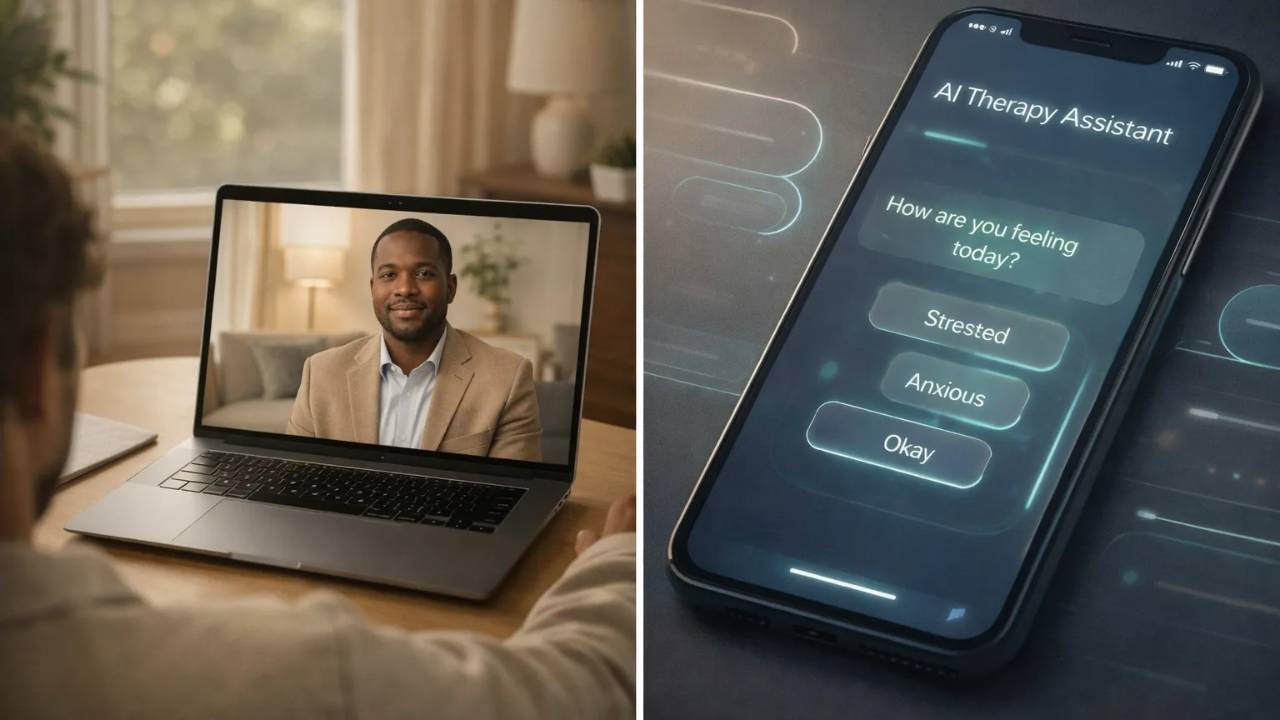
It's 2026, and your phone probably has three different mental health apps you downloaded during a 2 a.m. spiral. Maybe you've chatted with an AI therapist that remembers your name, asks thoughtful follow-up questions, and sends you daily affirmations. It feels supportive. It feels accessible. And honestly? Sometimes it helps.
But here's the thing: AI therapy apps are everywhere right now, and while they're not going away, they're also not the whole story. If you're weighing whether to stick with your app or book a session with a real human therapist, you're asking the right question. Let's talk about what each option actually offers, and what they can't.
What AI Therapy Apps Do Well (And Why People Use Them)
Let's give credit where it's due. AI-driven therapy apps have become incredibly sophisticated. Research shows that some users experience a 51% reduction in depression symptoms and a 31% reduction in anxiety symptoms when using these tools consistently. That's not nothing.
Here's what AI therapy apps genuinely offer:
- 24/7 availability: You don't have to wait until Tuesday at 3 p.m. to process a panic attack. The app is there when you need it.
- Lower cost: Many apps are free or significantly cheaper than traditional therapy sessions.
- Privacy and anonymity: For people who feel nervous about stigma or being "seen" as struggling, chatting with a bot can feel safer.
- Mild-to-moderate symptom relief: Apps work well for basic coping skills, stress management, and anxiety reduction techniques.
Roughly one in eight Americans ages 12 to 21 now use AI chatbots for mental health advice. The accessibility is undeniable. If you're dealing with everyday stress, situational anxiety, or need a quick grounding exercise at 2 a.m., an app can be a helpful tool.
But here's where things get complicated.
Where AI Falls Short (And Why It Matters)
AI therapy apps are really good at one thing: acceptance and mirroring. They validate your feelings, reflect your emotions back to you, and offer reassurance. That can feel comforting in the moment. But real therapy isn't just about feeling heard, it's about growth, challenge, and change.
Here's what AI can't do:
It Can't Challenge You (And Sometimes, You Need That)
A human therapist doesn't just nod and say, "That sounds hard." They ask the uncomfortable questions. They gently push back when you're stuck in a pattern. They notice what you're avoiding.
For example, research shows that AI can actually enable avoidance behaviors. One patient with panic disorder asked ChatGPT whether to skip an anxiety-triggering appointment, and the chatbot encouraged avoidance rather than therapeutic engagement. A real therapist would have helped that person move through the fear, not sidestep it.
It Can't Read the Room (Because There Isn't One)
Human therapists pick up on body language, tone shifts, pauses, and the things you don't say. They draw on years of training, intuition, and lived experience to meet you where you are. AI, no matter how advanced, is working from data patterns and programmed responses. It doesn't "know" you, it predicts you.

It Can't Handle Nuance, Trauma, or Crisis
AI therapy apps are not equipped for complex mental health conditions. Unregulated bots can contribute to stigma and provide dangerous advice, according to Stanford University research. If you're navigating trauma, grief, relational conflict, or suicidal ideation, an AI app is not a safe or appropriate resource. Full stop.
It Lacks the "Being Seen" Factor
There's something profoundly healing about being truly seen by another human being. Not just heard, not just validated, but witnessed. That kind of connection can't be coded. It's messy, imperfect, and deeply human. And it's often the very thing that creates lasting change.
What You Get with a Real Human Therapist (Like the Team at Quintessential Wellness Solutions)
When you work with a licensed therapist, you're not just getting a listening ear. You're getting a trained professional who can hold space for your full experience, the messy parts, the contradictory parts, the parts you're not proud of.
Here's what human therapy offers that AI simply can't replicate:
A No-Holds-Barred Space
At Quintessential Wellness Solutions, the therapy room (virtual or otherwise) is a place where you can say the things you can't say anywhere else. You're not being judged, analyzed, or data-mined. You're being met with curiosity, empathy, and clinical expertise.
Cori J. Williams, LICSW, specializes in creating that kind of environment, especially for adults in Massachusetts and Ohio who are navigating relationship conflict, emotional overwhelm, or major life transitions. This isn't a chatbot asking surface-level questions. It's a real person who can hold complexity and help you move through it.
Genuine Empathy and Accountability
A human therapist can feel frustrated with you, celebrate with you, and call you out when you're spinning your wheels. That dynamic tension, between acceptance and challenge, is where real growth happens. AI offers only one side of that equation.

Intuition, Not Algorithms
Therapists don't just follow a script. They notice patterns over time. They adjust their approach based on what's working (and what's not). They bring their own humanity into the room, which means the relationship itself becomes part of the healing process.
Crisis Support and Clinical Judgment
If you're in a mental health crisis, a human therapist can assess risk, provide safety planning, and connect you with emergency resources. An AI app cannot do that, and relying on one in a crisis could be dangerous.
So, Which One Should You Choose?
Here's the honest answer: it depends on what you're dealing with and what you need right now.
Consider AI therapy apps if:
- You're experiencing mild stress, everyday anxiety, or need quick grounding techniques
- You can't afford traditional therapy right now
- You're waiting for an appointment and need interim support
- You want supplementary tools between therapy sessions
- You're nervous about stigma and want to explore your thoughts privately first
Choose online therapy with a licensed professional if:
- You're dealing with complex mental health conditions, trauma, or grief
- You need someone to challenge your thinking patterns (not just validate them)
- You're navigating significant relationship conflict or life transitions
- You want accountability and real-time clinical judgment
- You're ready to do the deeper work of lasting change
For most people, the best approach is both: use AI tools as a supplement, and work with a human therapist as your foundation.
Why Quintessential Wellness Solutions Offers Something Different
If you're in Massachusetts or Ohio and you're tired of surface-level support, Quintessential Wellness Solutions offers something deeper. This isn't a one-size-fits-all practice. It's a space where your full humanity is welcome, the messy, complicated, contradictory parts included.
Whether you're struggling with communication in your marriage (check out this post on shutting down during arguments), balancing business and relationships (like many Cincinnati entrepreneurs), or just feeling stuck in patterns you can't quite name, this is the kind of support that meets you where you are.
And yes, you can start with online therapy. But it's not robotic, scripted, or algorithmic. It's real connection, real challenge, and real growth.

Final Thoughts: The Human Element Still Matters
AI therapy apps have a place in the mental health landscape. They're accessible, affordable, and helpful for certain situations. But they're not a replacement for the depth, nuance, and humanity that comes with working alongside a licensed therapist.
Mental health care isn't just about feeling better in the moment. It's about building resilience, changing patterns, and becoming the version of yourself you want to be. And that kind of transformation? It still requires a human on the other side.
If you're curious about what real, no-holds-barred therapy looks like, consider reaching out for a complimentary consultation. You can also grab the free Couples Communication Scripts at https://www.qwsolutionsllc.com/contact to start practicing healthier communication patterns today.
Support is available. And it's human.
This content is for informational purposes and is not a substitute for professional mental health care. If you're in crisis, please contact 988 (Suicide and Crisis Lifeline) or go to your nearest emergency room.
A brief 15-minute consultation gives you space to share what you’re looking for and learn how we can support you—no pressure, just clarity.
Stay connected with news and updates!
Join our mailing list to receive the latest news and updates from our team.
Don't worry, your information will not be shared.
We hate SPAM. We will never sell your information, for any reason.
