
The Ultimate Guide to Rebuilding Trust After Infidelity: How Marriage Counseling Can Help
Feb 11, 2026
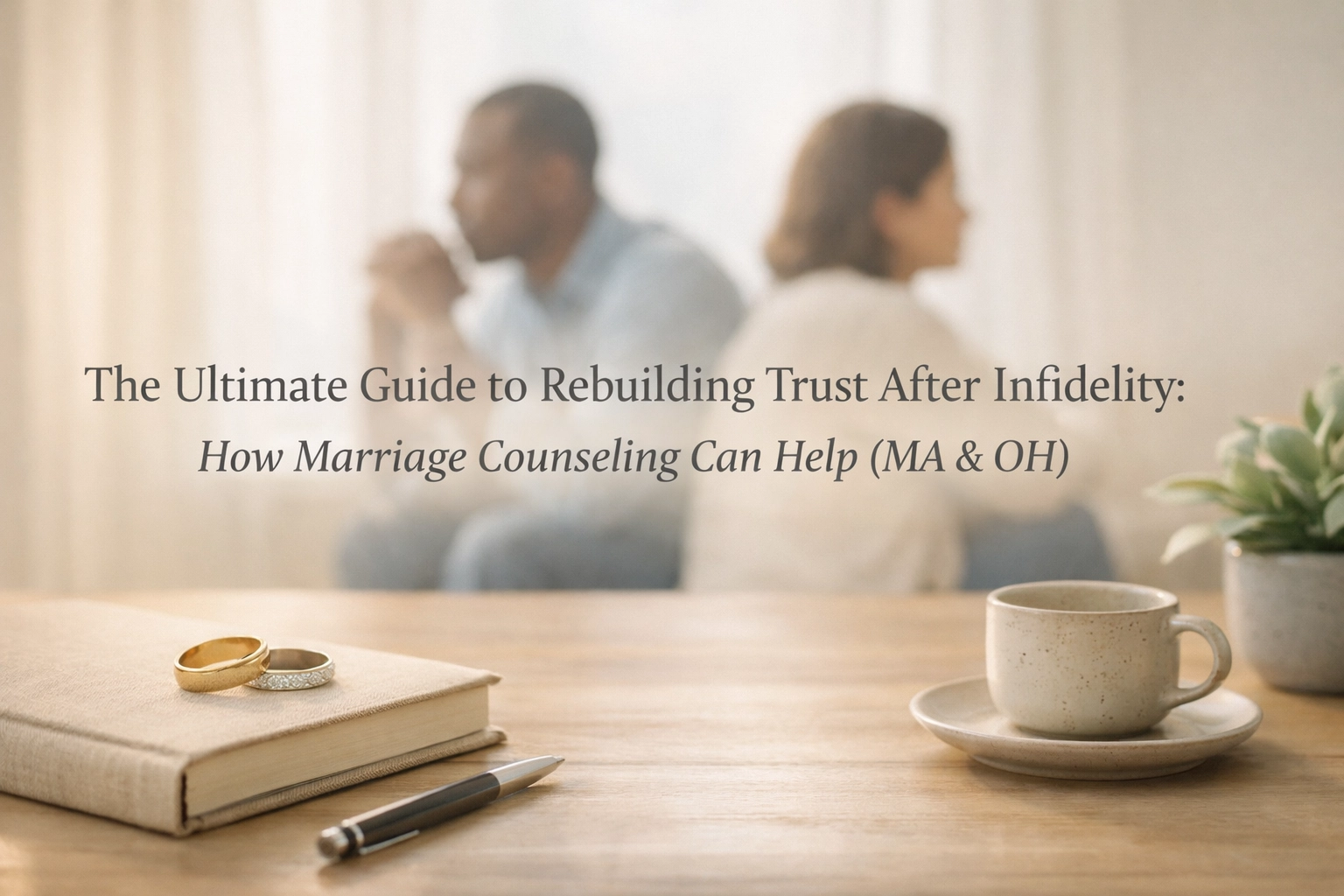
Let's not sugarcoat it: infidelity blows up your world. Whether you're the one who stepped out or the one who just discovered your partner's betrayal, you're probably sitting there wondering if this is even salvageable. Maybe you're Googling at 2 a.m. in Massachusetts or Ohio, desperately searching for someone to tell you there's a way forward, or permission to walk away.
Here's the truth: rebuilding trust after infidelity is possible, but it's not easy, it's not quick, and it requires both of you to show up in ways you probably never have before. This isn't about "getting over it" or "moving on." It's about deciding whether you want to rebuild something entirely new, because the old relationship? That's done.
Is This Even Fixable? The Question Everyone Asks
Let's start with the question that's eating at you: Can we actually come back from this?
The answer is: maybe. And that "maybe" depends entirely on two things:
- Is the unfaithful partner willing to do the hard, uncomfortable work of full accountability?
- Is the betrayed partner willing to explore whether forgiveness and trust-building are even on the table for them?
Notice we didn't say "Can you forgive and forget?" Because that's nonsense. You don't forget. You don't "get back to normal." What you can do is build something different, sometimes stronger, sometimes just different, if both of you are willing to put in the work.
At Quintessential Wellness Solutions, we specialize in marriage counseling in Massachusetts and Ohio, and we've worked with couples at every stage of this process. Some rebuild. Some realize they can't. Both outcomes can be healthy, depending on what you both need.

Full Accountability: Not Just "I'm Sorry"
Here's where most couples get stuck right out of the gate. The unfaithful partner says "I'm sorry," expects things to move forward, and then gets frustrated when their partner keeps asking the same questions or "won't let it go."
Let's be clear: accountability is not a one-time apology. It's a sustained practice.
Full accountability means:
- Owning your actions completely. No "but you weren't meeting my needs" or "I was going through a hard time." Those conversations come later, after you've taken full responsibility.
- Ending all contact with the affair partner immediately. No "closure" conversations. No "let me explain to them." It's over, and your partner needs to see that.
- Answering every question, even the repetitive ones. Yes, your partner may ask the same thing 50 times. That's not punishment: that's their brain trying to make sense of a trauma.
- Being transparent about the timeline, the lies, and the specific behaviors. The "trickle truth" game (where you only admit what you think they already know) will destroy any chance of rebuilding.
This part is painful. It feels like you're under a microscope. But if you're serious about rebuilding trust, this is non-negotiable.
Radical Transparency: It's Not Surveillance, It's Safety
After infidelity, your partner's sense of safety is shattered. They thought they knew you, and it turns out they didn't. So when we talk about transparency, we're not talking about handing over your phone for your partner to scroll through whenever they want (though some couples do this temporarily). We're talking about proactively removing the secrecy that made the affair possible.
What does that look like?
- Open communication about your whereabouts. If you're working late, say so ahead of time. If plans change, communicate immediately.
- Shared access to devices, accounts, and finances. This isn't about control: it's about demonstrating there's nothing to hide anymore.
- Transparency about your emotional state. If you're feeling disconnected, say it. If you're tempted, say it. Vulnerability is the antidote to secrecy.
For the betrayed partner, this transparency helps rebuild a sense of predictability. You're not trying to "catch" them: you're trying to feel safe again.
In our couples therapy in Massachusetts and Ohio, we help couples figure out what level of transparency feels right for their specific situation. Some couples need more structure initially; others need less. The key is that it's mutually agreed upon and reviewed regularly.

Understanding the "Why" (Without the Blame Game)
Here's where things get tricky. At some point, you both need to explore why the infidelity happened. But: and this is crucial: this conversation can only happen after full accountability is established.
If you jump to the "why" too soon, it becomes a justification. "I cheated because you weren't affectionate enough" is not accountability: it's blame-shifting. But once the unfaithful partner has owned their actions completely, you can start looking at the context:
- Were there unmet emotional needs in the relationship?
- Did the unfaithful partner have underlying issues with intimacy, attachment, or mental health?
- Were there communication breakdowns that left both partners feeling disconnected?
Notice we said "context," not "excuse." Understanding why something happened doesn't make it okay. But it does help you figure out what needs to change moving forward.
This is where marriage counseling in Ohio or Massachusetts becomes essential. A skilled therapist can facilitate these conversations without them devolving into a blame spiral. We'll help you identify patterns, explore vulnerabilities, and develop strategies to address the underlying issues that made infidelity possible.
How Marriage Counseling Actually Helps (And Why You Need It)
Let's get real: most couples can't do this alone. You're too close to it. Your emotions are too raw. And frankly, you probably don't have the tools yet to navigate conversations this high-stakes without it turning into a blowout fight or a silent standoff.
Here's what couples therapy in Massachusetts or Ohio provides:
- A neutral space where both partners can speak honestly without the conversation spiraling into defensiveness or shutdown. (If you tend to shut down during arguments, check out this post for more on that dynamic.)
- Evidence-based strategies like the Gottman Method or Emotionally Focused Therapy (EFT) that teach you how to repair connection, manage conflict, and rebuild intimacy.
- Trauma-informed support that helps the unfaithful partner understand that the betrayed partner's reactions: the flashbacks, the hypervigilance, the repeated questions: aren't "overreactions." They're normal responses to betrayal trauma.
- Practical tools like trust journals, shared calendars, and communication scripts that you can use between sessions.
At Quintessential Wellness Solutions, we don't just ask "how does that make you feel?" We give you actionable strategies. We're direct. We're not here to waste your time with vague reflections: we're here to help you rebuild, or help you figure out if rebuilding is even what you both want.

Practical Steps You Can Start Today
While therapy is essential, there are things you can start doing right now:
For the Unfaithful Partner:
- Write down a complete timeline of the affair. Don't wait for your partner to drag it out of you piece by piece.
- Check in proactively. Don't wait for your partner to ask where you are or what you're doing.
- Be patient with repetitive questions. Each time they ask, they're processing.
For the Betrayed Partner:
- Write down your questions and feelings in a journal. This can help you process before bringing it to your partner.
- Set boundaries around what you need to feel safe. It's okay to ask for transparency. It's also okay to decide this isn't worth rebuilding.
- Consider individual therapy alongside couples work. Betrayal is traumatic, and you need space to process your own experience.
For Both of You:
- Schedule weekly check-ins where you discuss how you're feeling about the rebuilding process.
- Create predictable routines together: shared meals, weekend walks, bedtime rituals. Predictability helps rebuild safety.
- Practice reflective listening: repeat back what you heard your partner say before responding. This reduces defensiveness and helps you both feel heard.
What to Expect: The Real Timeline
Here's the part no one wants to hear: rebuilding trust takes months to years, not weeks. There's no shortcut. Every honest conversation, every kept promise, every moment of transparency adds a brick to the foundation you're rebuilding.
Some days will feel like progress. Other days, something will trigger your partner (a song, a place, a date on the calendar) and it'll feel like you're back at square one. That's normal. Healing isn't linear.
Research suggests that couples who successfully rebuild after infidelity often report that their relationship becomes stronger and more authentic than it was before. But that only happens if both partners commit to the process: not just for a few weeks, but for as long as it takes.
Why Online Therapy Works for MA & OH Couples
If you're a busy couple juggling work, kids, and life in Massachusetts or Ohio, the idea of driving to a therapist's office every week might feel like one more thing you don't have time for. That's where online therapy becomes a game-changer.
With Quintessential Wellness Solutions, you can access marriage counseling in Massachusetts or couples therapy in Ohio from your own home. That means:
- Privacy. No running into someone you know in a waiting room.
- Convenience. Log in from your living room, office, or wherever feels safe.
- Flexibility. Evening and weekend sessions that work around your schedule.
The principles of trust-building are universal, whether you're meeting us in person or online. What matters is that you show up, do the work, and give yourselves the space to heal: or the clarity to make a different choice.

You Don't Have to Do This Alone
Infidelity doesn't have to be the end of your relationship: but it is the end of the relationship as it was. What comes next is up to both of you.
If you're ready to explore whether rebuilding is possible, or if you need support figuring out what your next step looks like, we're here. At Quintessential Wellness Solutions, we provide direct, evidence-based guidance for couples navigating the hardest moments of their relationships.
You can reach out for a complimentary consultation here. No pressure. No judgment. Just a conversation about what support might look like for you.
This content is for informational purposes and is not a substitute for professional mental health care. Rebuilding trust after infidelity is complex and deeply personal: what works for one couple may not work for another. If you're considering marriage counseling, speaking with a licensed professional can help you determine the best path forward.
A brief 15-minute consultation gives you space to share what you’re looking for and learn how we can support you—no pressure, just clarity.
Stay connected with news and updates!
Join our mailing list to receive the latest news and updates from our team.
Don't worry, your information will not be shared.
We hate SPAM. We will never sell your information, for any reason.
