
The Clinical Blind Spot: Why Traditional Therapy Fails Black Men and How to Actually Heal
Mar 16, 2026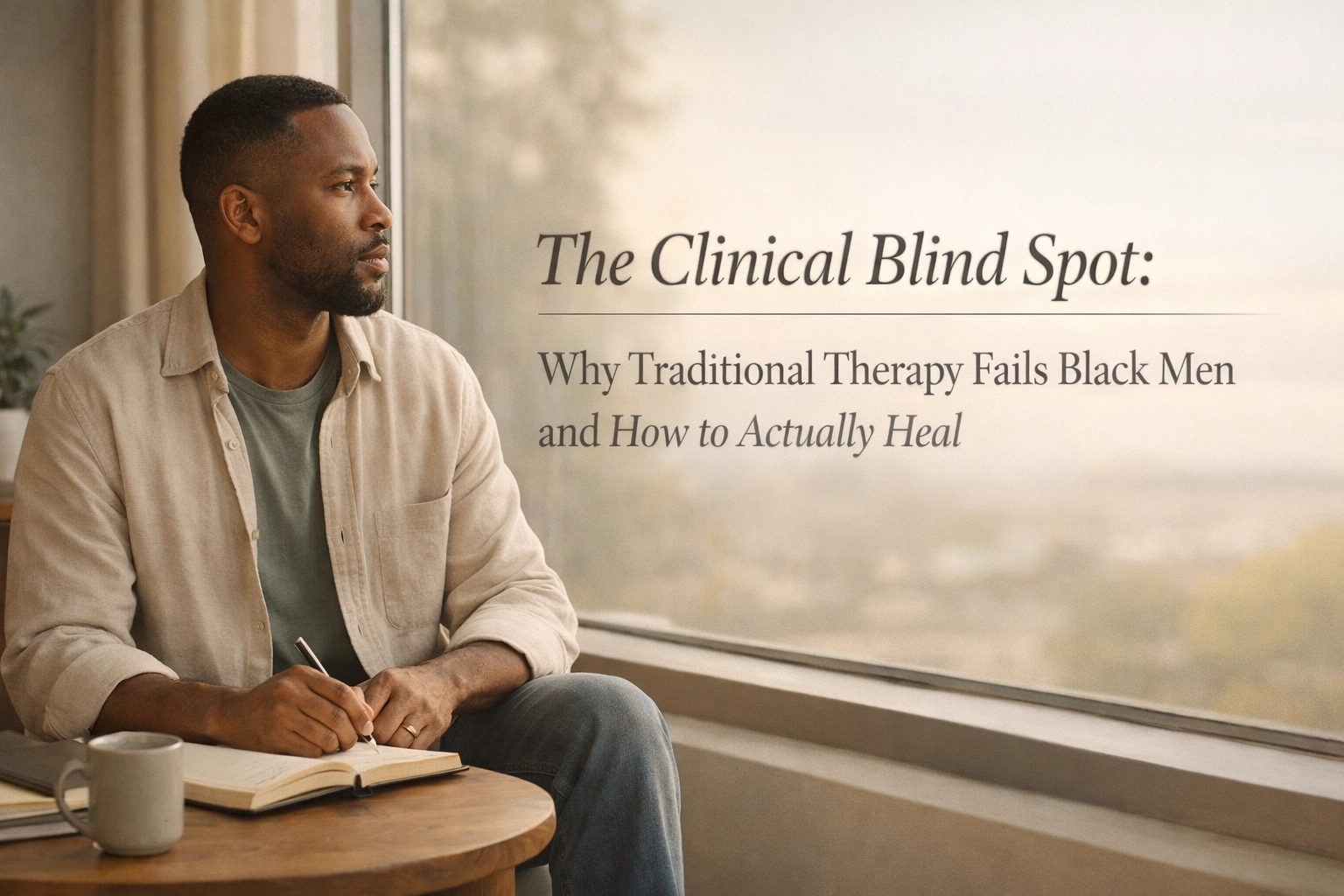
For many high-achieving Black men, the decision to enter therapy is a calculated move. You are used to optimizing your life: your career, your fitness, your investments. But when the internal ROI starts to dip, when the pressure of being the "only one" in the boardroom meets the weight of being a provider at home, you look for a professional to help recalibrate.
The problem? Many walk into a therapist’s office only to find a clinical environment that feels foreign, or worse, dismissive. There is a specific kind of frustration that occurs when you realize your therapist is operating from a playbook that doesn't account for your reality. At Quintessential Wellness Solutions, we recognize that this isn't just a "vibe" issue; it is a clinical blind spot that can lead to misdiagnosis, stunted progress, and a complete breakdown of the therapeutic alliance.
Traditional therapy often fails Black men not because the men are "resistant," but because the systems themselves were never designed to hold the weight of systemic racism, generational trauma, and the unique environmental stressors that Black men navigate daily.
The Myth of the "Resistant" Client
In clinical circles, there is a tired narrative about "the resistant Black male client." This label is often applied when a man doesn't immediately dive into "therapy speak" or when he maintains a level of guardedness.
From a diagnostic perspective, what some clinicians call "resistance" is actually a highly functional adaptation. Research suggests that what is often termed "healthy paranoia" is a rational response to historical medical racism and contemporary systemic bias. If you have spent your life navigating environments where you have to be twice as good to get half as much, walking into a room and immediately handing over your psychological "keys" to a stranger: who may or may not understand your context: isn't always the logical first step.
When a therapist fails to recognize this, the treatment misses the mark. Instead of building trust, the clinician may spend weeks trying to "break down walls" that are actually necessary structural supports for that man's survival in the outside world.

The Environmental Variable: Systemic Racism as a Clinical Stressor
Traditional therapy: especially models rooted in Western individualism: tends to focus almost exclusively on the internal landscape: your thoughts, your childhood, your ego. While those matter, they don't exist in a vacuum.
For a Black man, the environment is a constant clinical variable. You cannot talk about "anxiety" without talking about the physiological impact of navigating police encounters or the subtle, daily erosions of microaggressions in corporate spaces. When a therapist ignores systemic racism, they are essentially trying to treat a person for smoke inhalation while the house is still on fire.
This clinical blind spot leads to what we call "misattunement." If you describe the stress of a toxic workplace and your therapist responds with "Have you tried deep breathing?" without acknowledging the racial dynamics at play, the therapy has failed. It has prioritized a coping mechanism over the validation of a systemic reality. Many individuals find that without this acknowledgment, therapy feels like another space where they have to "perform" or educate their provider.
Generational Trauma and the "Strong Black Man" Script
There is a diagnostic cost to the "Strong Black Man" trope. Generational trauma isn't just a buzzword; it’s the way survival strategies are passed down through DNA and family narratives. For many Black men, vulnerability was historically a liability. Showing emotion could be dangerous: not just socially, but physically.
This results in a specific presentation of symptoms that traditional therapy often misses. Depression in Black men may not look like crying or "sadness." It often presents as:
- Irritability or "Short Fuse" Syndrome: Anger is a more "acceptable" emotion in many circles than grief.
- Over-functioning: Throwing yourself into work or the gym to avoid the void of burnout.
- Somatic Complaints: Unexplained back pain, headaches, or digestive issues that are actually manifestations of suppressed emotional distress.
If a clinician isn't trained to see these as clinical markers of trauma or depression, they may simply label the client as "angry" or "difficult." This mislabeling can have devastating consequences for a man’s career and his marriage.
At Quintessential Wellness Solutions, we emphasize that diagnosis matters. When the language of therapy is too "pink" or too focused on soft vulnerability without acknowledging the need for tactical strength, men often check out.

The "Colorblind" Fallacy in Clinical Practice
"I don't see color; I just see a human being."
In a therapeutic setting, this sentence is a red flag. While it may be well-intentioned, it is clinically irresponsible. To not see color is to choose not to see the client's full reality. It means the therapist is blind to the way the world treats that client.
When a therapist adopts a colorblind approach, they inadvertently signal that they are not a safe space for the "hard" conversations. If a man can’t talk about the psychological cost of white supremacy or the pressure of being the "representative" for his race in high-stakes environments, the therapy stays on the surface.
This is why specialized care is not a luxury: it is a clinical necessity. Support is most effective when the person sitting across from you doesn't need a 101-level course on your existence before the actual healing work begins.
Breaking the Cycle: What Effective Support Looks Like
Healing for Black men requires a shift from traditional, passive listening to a more direct, informed, and culturally nuanced approach. It involves:
- Acknowledging the "Adulting Tax": Recognizing that for Black men, the cost of success often includes a high level of hypervigilance.
- Addressing the Language Gap: Moving away from "how does that make you feel?" toward "how is this impacting your ability to lead/provide/thrive?"
- Integrating Environmental Realities: Treating the individual while acknowledging the systemic factors that contribute to their stress levels.
- Specialized Spaces: Some men find that they need spaces specifically designed for their experiences, such as the Iron Sharpens Iron initiative at Quintessential Wellness Solutions, which focuses on the unique pressures of the Black male experience.

The Path Forward
Traditional therapy may have missed the mark in the past, but that does not mean healing is out of reach. It means the "how" matters just as much as the "who."
For the high-achieving Black man, the goal isn't just to "feel better." The goal is to gain the clinical tools to navigate a complex world without losing your peace, your health, or your relationships. Whether you are dealing with the 2026 anxiety cocktail of politics and racial discord or trying to save a marriage that has been strained by the "strong man" mask, specialized support can help clarify the path.
If this resonates with you, it may be time to consider a different kind of clinical conversation. One that doesn't ask you to leave your identity at the door.
Learning more about specialized approaches can be a helpful first step in finding care that actually hits the mark. If you're ready to explore what that looks like, you may consider scheduling a consultation with a professional who understands the clinical nuances of your reality.
This content is for informational purposes and is not a substitute for professional mental health care. At Quintessential Wellness Solutions, we are committed to providing informed, culturally competent support for individuals and couples navigating complex life challenges.
Quintessential®™ is a registered Trademark owned by Quintessential Wellness Solutions.
A brief 15-minute consultation gives you space to share what you’re looking for and learn how we can support you—no pressure, just clarity.
Stay connected with news and updates!
Join our mailing list to receive the latest news and updates from our team.
Don't worry, your information will not be shared.
We hate SPAM. We will never sell your information, for any reason.
